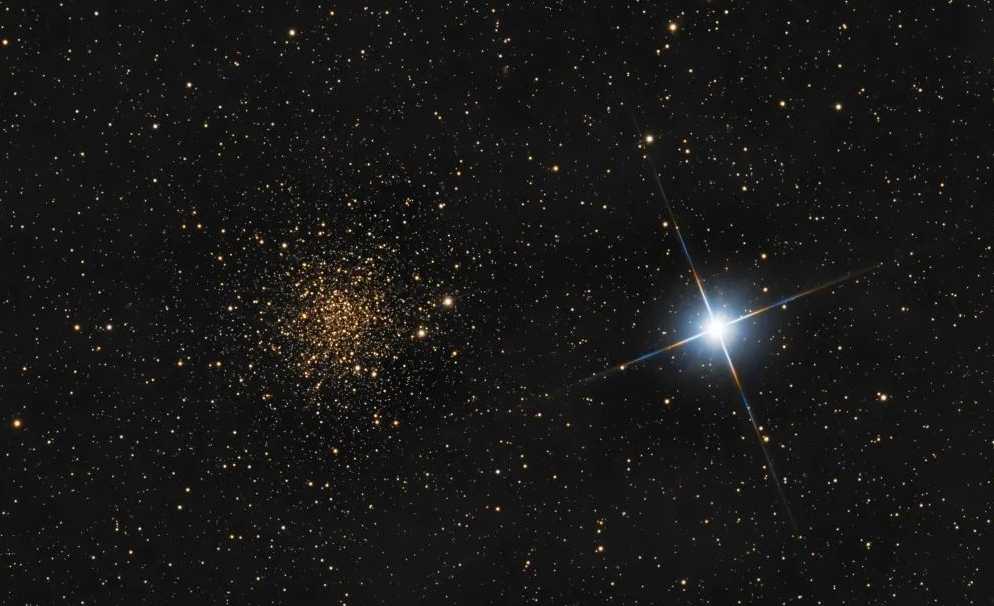
While most globular clusters orbit in the Milky Way’s outer halo, NGC 6366 stands out by lingering close to the galactic plane. Located ~12,000 light-years from Earth in Ophiuchus, the cluster’s starlight dims and reddens as it passes through interstellar dust—a phenomenon known as interstellar reddening. In this telescope image, NGC 6366’s golden stellar swarm contrasts sharply with the blue-white star 47 Ophiuchi, just 100 light-years away and visible as a bright point near the cluster’s edge.
NGC 6366’s unusual location near the dusty galactic plane subjects it to greater interstellar extinction than typical halo clusters. This reddening, caused by dust particles preferentially scattering blue light, gives the cluster’s stars a warmer hue. Astronomers estimate the dust along the line of sight reduces NGC 6366’s apparent brightness by ~1.5 magnitudes, requiring careful calibration to study its stellar populations.
"Most globular clusters avoid the galactic plane to escape dust and gravitational disturbances," says Dr. Marina Geller of the University of Colorado. "NGC 6366’s proximity makes it a unique case for studying how clusters survive in a crowded, dusty environment."
- NGC 6366: Home to hundreds of thousands of gravitationally bound stars, all over 10 billion years old. Its dense core and sparse outer regions showcase the classic globular structure, with variable stars and white dwarfs hidden among the crowd.
- 47 Ophiuchi: A binary star system (not a cluster) consisting of two Sun-like stars separated by ~10 astronomical units. Though unresolved in the image, spectroscopic data reveals their orbital motion, with a period of ~800 years.
The contrast highlights a key astronomical distinction: globular clusters are ancient stellar cities, while most bright "stars" in the night sky are nearby single or binary systems. NGC 6366’s proximity to 47 Ophiuchi creates a misleading visual association, but their distances and natures differ profoundly.
NGC 6366’s location near the galactic plane exposes it to gravitational tugs from passing stars and gas clouds, which could strip its outer stars over time. Yet the cluster remains tightly bound, suggesting a robust structure. Studies of its variable stars and heavy-element abundances (metallicity) reveal similarities to other halo clusters, implying it may have migrated to its current position rather than forming here.
As telescopes peer through the dust to study NGC 6366, this cosmic oddity continues to challenge assumptions about globular cluster evolution—proving that even in the well-mapped Milky Way, exceptions to the rules can reveal some of the galaxy’s deepest secrets.