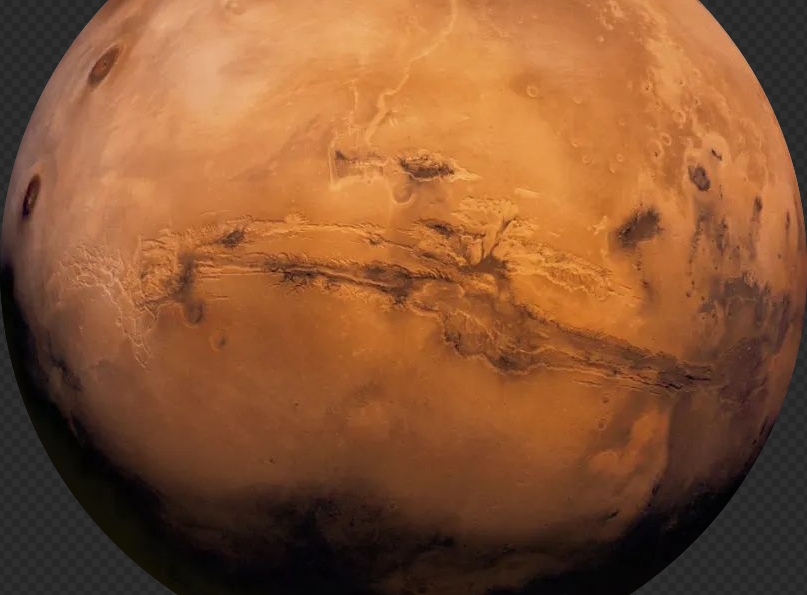
Mars, once a potentially habitable world, now bears only the faint traces of a once-mighty magnetic field. Unlike Earth’s global magnetic shield, Mars’ ancient dynamo shut down billions of years ago, leaving behind patchy magnetic anomalies—silent witnesses to a pivotal event that reshaped the planet’s environment. How did Mars lose its magnetic field, and what does this mean for its habitability?
Earth’s magnetic field arises from convective motions in its liquid iron-nickel core, but Mars—with a diameter just half of Earth’s—cooled too quickly. Planetary scientists believe that ~4 billion years ago, Mars’ core solidified, halting the convective currents that generated its global field. This "dynamo shutdown" occurred because:
- Small Size Drives Faster Cooling: Mars’ smaller mass meant it retained less internal heat from formation, causing its core to solidify earlier than Earth’s.
- No Plate Tectonics to Regenerate Heat: Unlike Earth, Mars lacks active plate tectonics, which recycle heat and sustain core convection.
The final nail in the coffin: without a magnetic field, Mars lost its primary defense against the solar wind—a stream of charged particles from the Sun.
-
Atmospheric Erosion by Solar Wind
Earth’s magnetic field deflects most solar wind particles, but Mars’ unprotected atmosphere became vulnerable. Over millions of years, the solar wind:
- Stripped away atmospheric gases (carbon dioxide, nitrogen) via ion sputtering.
- Reduced atmospheric pressure from ~1 bar (Earth-like) to its current ~6 millibars—too thin to support liquid water on the surface.
-
Climate Catastrophe: The Death of Surface Water
With a thinning atmosphere:
- The greenhouse effect weakened, causing global temperatures to plummet (average ~-63°C today).
Surface water—abundant in Mars’ early history—evaporated or froze, leaving only polar ice caps and subsurface brines.
-
Geological Fossils: Magnetic Anomalies in the Crust
Though the global field vanished, Mars’ southern hemisphere hosts striped magnetic anomalies in its crust. These are "fossil fields" frozen into the rock when the planet’s early crust solidified, recording the ancient dynamo’s polarity reversals—similar to Earth’s magnetic striping at mid-ocean ridges.
-
A Window into Planetary Decline
Mars’ magnetic collapse offers a stark case study: without a magnetic shield, a planet’s habitability can deteriorate rapidly. This insight informs the search for exoplanets, emphasizing the importance of magnetic fields in sustaining life.
-
Searching for Ancient Life Signals
Mars may have harbored life when its magnetic field and atmosphere were intact. Missions like NASA’s MAVEN (Mars Atmosphere and Volatile Evolution) study how the solar wind eroded the atmosphere, while rovers like Perseverance seek fossilized microbial remains in ancient riverbed sediments.
-
Could Mars’ Magnetic Field Be Restored?
Hypothetical plans to terraform Mars propose creating an artificial magnetic field (e.g., via orbiting superconducting rings), but such technology remains far-fetched. For now, Mars’ magnetic remnants serve as a cosmic reminder of how a planet’s internal physics can dictate its evolutionary path—and whether it becomes a cradle of life or a frozen red desert.
In the silence of Mars’ lost magnetic field lies a profound lesson: in the universe, survival often hinges on the delicate balance between a planet’s inner workings and the harsh forces of space.